Doing what we’re told
People are most furious when you take away their autonomy, one need look no further than a cancelled train or gridlocked traffic to see people beside themselves with anger. Being told what to do induces anger and humiliation even if you were going to do what you’ve been told to do anyway. We all have the desire to choose what we do and rebel against what we are told.
Then why, when a score is placed in front a musician do they have the instant desire to do what they’re told quickly and precisely. If they can’t do exactly as they’re told they despise themselves and they mock people around them who are trying to do what they’re told but can’t. Does it come from a fondness for the composer? Why trust a stranger so completely?

This shift from freedom to obedience in music is clear on a larger time frame. As the world has become more free music has become more strict. If you compare the score to Monteverdi’s Orfeo with Thomas Ades’ Exterminating Angel you can see this change clearly at a glance. Montiverdi provides the bare minimum in notation and relies on the performers to improvise within his frame work whilst Ades provides is meticulously detailed and asks his performers to accomplish rhythmic difficulties right at the brink of human capability. It seems bizarre that a society that values freedom above all else would champion art that is more and more controlled.
I spent 2 years to trying to do exactly as Stockhausen told me. Stockhausen famously had a cult following of performers that really wanted to do what he told them to do. I’ve asked my teachers their thoughts on Stockhausen and their thoughts vary from ‘he’s a bit controlling’ to ‘he’s a bit of a facist’. It’s obvious that you’d have to think very carefully about following the strict instructions of someones who’s ‘a bit of a facist’ yet I had already begun learning his music and continued to do so without concern for the composers ideology.
Any other format invite scrutiny: you do not follow a rule just because it is written down, you question why it has been written down and who wrote it. Maybe that scrutiny has always been done for us. In the context of music college the music which makes it on to our stands has been scrutinised by our teachers and thus our trust is in our teachers rather than the dead stranger who wrote the piece.
There are words that an actor would feel uncomfortable speaking, words that are clearly not meant for them. But is there music which would induce the same feeling? Have you ever sat in front of a score and thought ‘this is not for me to play’.
Musicians are portrayed as hedonistic dropouts from society, failing to conform to normal standards of work and living. Everyone has the sense that they are pushing against something, that the world would rather you be something else or as a teacher said to me ‘you’re not doing the world any favours by becoming a saxophonist’. Yet we do what we’re told far more than any accountant or solicitor. Punk rock is full of anarchists that are very good at doing what they’re told.

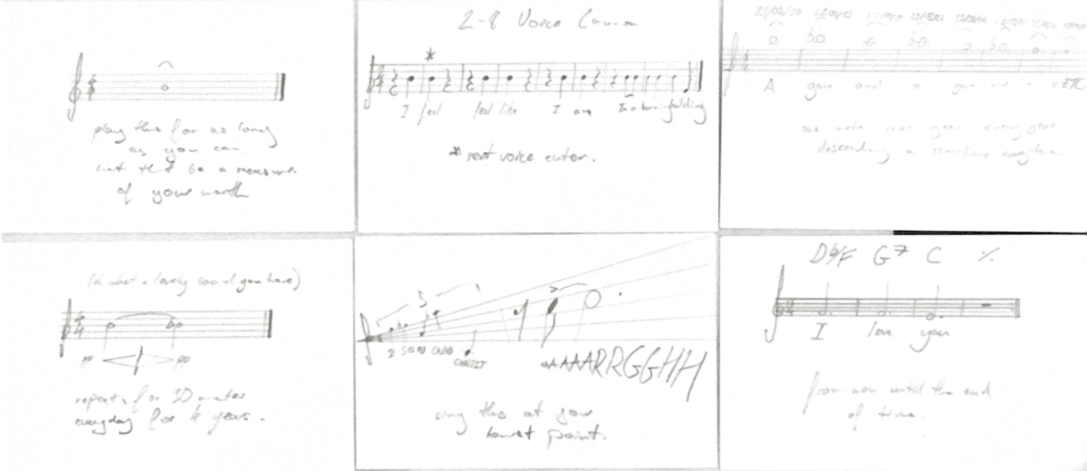
I have written 100 musical scores on business cards which often require the performer to be ridiculous. I didn’t start writing these scores with this manifesto in mind. Many times I would get to the end of the day and think ‘I haven’t achieved anything’ so I started writing at least one little score everyday so I had concrete evidence that I had done something. It was only after writing a few that I realised how strange it was that scores have so much power over us. I was also aware of how much power a grading system had over the music I was writing; everything had to be taken very seriously because it was going to be marked as part of my degree. Now I’m free from those restrictions I can be as ridiculous as I like.
Of course, music is part of a wider rebellion. By playing music you are rebelling against the empirical world, you’re rebelling against the idea that all we see is all their is. In a less metaphysical sense you’re rebelling against a more conventional career path. Ultimatly, the pay off is worth it, you do what your told (and practice) for long enough that your entire life can become a rebellion.

 Nicholas Hann