My neurologist laughed when I said I teach clarinet and recorder in schools, they said that couldn’t possibly be good for migraines. In response to people saying, ‘that must be so difficult for you’ my stock reply has become ‘my life would be very difficult if it wasn’t so easy’. A classroom full of children with clarinets may sound like a chronic migraine sufferers nightmare but the reality is teaching often offers me a momentary refuge from the pain. I welcome anything that demands my total attention. Distraction works well as a pain killer and adrenaline is even better. The more nerve-racking a situation is, the clearer my mind becomes. Paradoxically, in the weeks leading up to my final exams at Guildhall, I would be pain-free for hours at a time because of the stress.
At points, when the pain is persistent it is tempting to believe that the pain is deserved as then it would make some sort of sense but, of course, an illness doesn’t know anything about justice. Recently, I have begun to think of the migraine as a benevolence. It functions as a safety pin or a pressure release valve. With the real world becoming too difficult to comprehend my brain decided to leave it. The senses cease to function, the ground moves and people glow; one is reminded that there is far more to the world than our senses can show and it becomes ridiculous to worry too much about what you see and hear. Music has this effect also, in a much more pleasant way, it can make you feel separated (and safe) from reality.
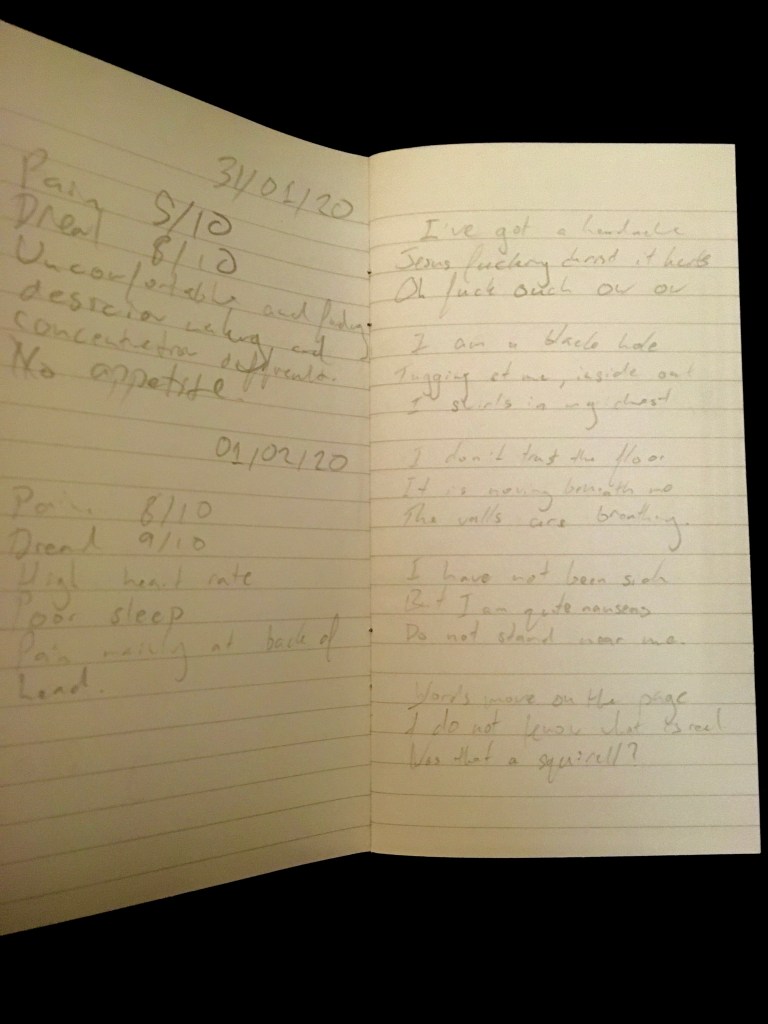
Music and migraine combined make for a transcendent experience. There were a few points at the end of my time at Guildhall when I’d be in intense pain during a rehearsal with my earplugs in and my eyes closed, I could feel my senses getting more and more overwhelmed. I would then have a desire to open my eyes and remove my earplugs, a panic akin to claustrophobia. My over-sensitive eyes and ears would be flooded with light and sound, for a few moments I’d feel an incredible calm as I left the world (senses enveloped in music) then a sledgehammer would hit me in the back of the head and the earplugs would go back in again.
It is important to appreciate the positives whilst not dismissing the negatives. Of course, what goes up must come down. A day of teaching fuelled by painkillers and adrenaline will always end with pain akin to being hit on the back of the head with a plank. I find it very difficult to turn down/rearrange work for the sake of my health. Ultimately, most of the time the migraine is bearable. I may be in so much pain that I occasionally need to go and vomit but with a great deal of physical and mental effort, I can create the illusion that my brain is functioning normally. There is little energy from anything else, going to the pub or going to a concert seems impossible. Thus this illness has stolen a lot of fun from me. I am learning that it is acceptable to rearrange work to allow myself to have enough energy to not crash at the end of the day; healthy people are not expected to work to the point that they collapse and nor should I.
For me, the pain is a small part of the migraine. Far more unpleasant is nausea and confusion. In day to day life, I used to take for granted my ability to make decisions. When you make a cup of tea you have to think of what order to do everything in, this probably doesn’t seem like a mental exercise because it’s so simple but this basic decision making requires a functioning brain. Having lost the ability to order my thoughts I can often end up wandering round in circles. At this point music helps a lot: I have spent (10 years now) habitually ordering my thoughts in the form of practicing music. Running scales and patterns up and down seems to reset my brain, it begins to understand which order things should come in. If I’m not near a piano I can run the scales in my head and the visualisation of my thumbs moving under my fingers seems to remind my brain that thoughts must come one at a time, one after the other.
In Musicophilia Oliver Sacks says he experienced amusia (the total inability to recognise music) as part of his migraine aura, he said the sound of the piano disintegrated into industrial noise. I think this anecdote shows the power of migraine over perception. Music is something that only exists in our brains. It has to be processed and migraine is capable of effecting any element of that mental process. Luckily, my migraines have never brought on amusia and if anything they increase the effect music has on me probably because my hearing and eyesight become hypersensitive (which is horrible when you’re trying to sleep but quite exciting when in front of an orchestra).
I know little about music therapy and how it could be applied to migraine sufferers but it is something I will look into. An illness that affects so many different parts of the brain demands a therapy which, equally, uses the whole brain. I have found that music works as an all-consuming distraction but, more interestingly, I have found its ability to reorder my mind when I have become confused. Perhaps, I should try to come up with the perfect practice routine for resetting the mind. Confusion usually comes before the pain I may even be able to avoid the pain by practicing during the confusion stage of the migraine!
I would be very interested to hear from other musicians suffering from migraines and whether they’ve found music helps or worsens the attacks.

 Nicholas Hann
This is so fascinating Nick and does seem to highlight the similarities between migraine and epilepsy.
LikeLike
I learnt classical piano as a child, getting successfully to Grade 8. In the decades since, I have not played much, for various reasons. However, I can still sit down at a piano with my (at best) Grade 4 skills, and within 5 minutes of playing be in the zone, in a state of absolute bliss, disconnected from everything else. I will get up a few minutes later and learn that an hour or more has passed. There is definitely something about playing music and re-ordering one’s brain.
LikeLike
I remembered the words of Indian musician, Gita Sarabhai, who was a friend of John Cage, that the purpose of music is “to sober and quiet the mind, thus rendering it susceptible to divine influences.”
LikeLike